BEGIN:VCALENDAR
VERSION:2.0
PRODID:-//TYPO3/NONSGML Calendarize//EN
BEGIN:VEVENT
UID:calendarize-vieslekcija-beyond-the-classroom-embracing-a-holistic-view-of-chemistry-to-tackle-modern-challenges
DTSTAMP:20260429T105501Z
DTSTART:20260505T111000Z
DTEND:20260505T130000Z
SUMMARY:Vieslekcija "Beyond the Classroom: Embracing a Holistic View of Chemistry to Tackle Modern Challenges"
DESCRIPTION:\nLekcijā profesors pievērsīsies mūsdienu vides un sabiedrības izaicinājumiem\, uzsverot nepieciešamību ķīmijas izglītībā attīstīt holistisku un sistēmisku skatījumu uz dabaszinātņu lomu ilgtspējīgas nākotnes veidošanā. Tiks analizēts\, kā ķīmijas mācību saturā iespējams mērķtiecīgi integrēt sociāli nozīmīgus un starpdisciplinārus jautājumus\, lai stiprinātu studentu motivāciju\, pašefektivitāti un izpratni par ķīmijas saikni ar sabiedrību\, vidi\, ekonomiku un tehnoloģiju attīstību. Visi interesenti laipni gaidīti! Vieslekcija angļu valodā. \nVieslekcijas kopsavilkumu skatīt zemāk:Dr. Ozcan Gulacar UC Davis\, Department of Chemistry\, ASVhttps://scholar.google.com/citations?user=FKV0xEgAAAAJ&hl \nBeyond the Classroom: Embracing a Holistic View of Chemistry to Tackle Modern Challenges\nThe world is facing increasingly complex environmental and social challenges that demand a rethinking of both the goals and practices of science education. Addressing these challenges requires more than disciplinary knowledge\; it requires a systems-thinking perspective that helps learners understand how human activities\, natural systems\, technological development\, and economic forces are deeply interconnected. To develop such perspectives\, all students\, regardless of socio-economic background\, must cultivate a sense of responsibility for humanity’s impact on the environment and acquire the knowledge and skills needed to engage in sustainable decision-making. Science educators\, and chemistry educators in particular\, play a critical role in preparing students to meet these demands.\nDespite broad recognition within the scientific community of the importance of this mission\, student engagement has declined as instruction has increasingly emphasized abstract principles and algorithmic problem solving over the exploration of meaningful socio-scientific issues. As a result\, authentic real-world contexts and opportunities to investigate complex\, interdisciplinary problems are often replaced by decontextualized content and cookbook-style laboratory experiences.\nThis talk examines the challenges and opportunities associated with designing and implementing rich\, contextualized chemistry curricula that intentionally bridge theory and practice. Drawing on perspectives and examples from chemistry educators at primarily North American institutions\, the presentation highlights instructional approaches grounded in systems thinking and the use of socio-scientific issues\, including critical raw materials\, to illustrate the interdependence of society\, the environment\, the economy\, and technology. In particular\, the talk showcases how integrating topics such as phosphate sustainability and critical raw materials into General Chemistry can positively influence students’ motivation\, self-efficacy\, and perceptions of relevance. Ultimately\, the presentation emphasizes the central role of chemistry educators in fostering social responsibility and empowering students to engage thoughtfully with the complex global challenges that will shape a more sustainable future.
X-ALT-DESC;FMTTYPE=text/html:
\n
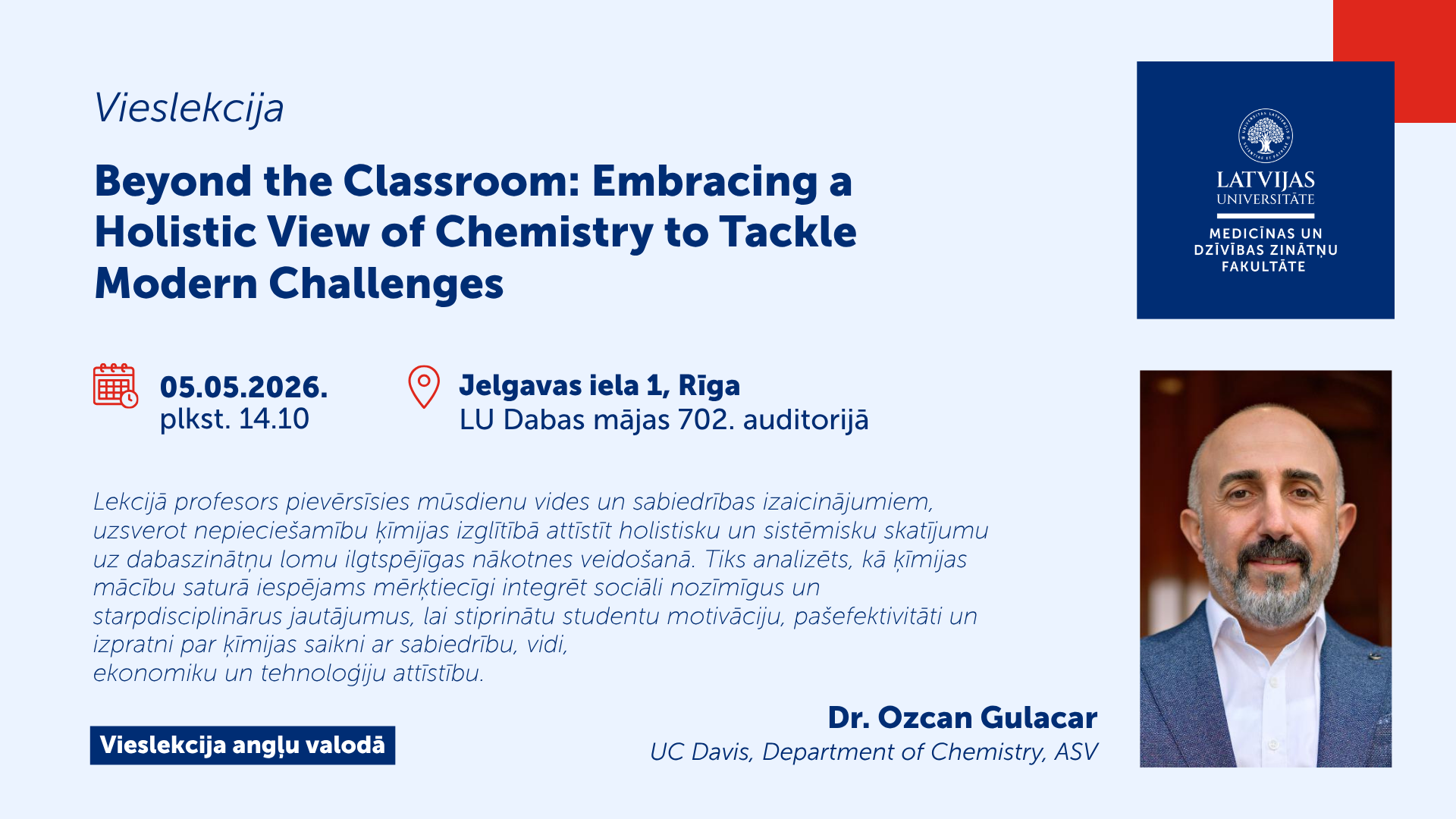
Lekcijā profesors pievērsīsies mūsdienu vides un sabiedrības izaicinājumiem\, uzsverot nepieciešamību ķīmijas izglītībā attīstīt holistisku un sistēmisku skatījumu uz dabaszinātņu lomu ilgtspējīgas nākotnes veidošanā. Tiks analizēts\, kā ķīmijas mācību saturā iespējams mērķtiecīgi integrēt sociāli nozīmīgus un starpdisciplinārus jautājumus\, lai stiprinātu studentu motivāciju\, pašefektivitāti un izpratni par ķīmijas saikni ar sabiedrību\, vidi\, ekonomiku un tehnoloģiju attīstību. Visi interesenti laipni gaidīti! \;
Vieslekcija angļu valodā. \;
\nVieslekcijas kopsavilkumu skatīt zemāk:
Dr. Ozcan Gulacar \;
UC Davis\, Department of Chemistry\, ASV
https://scholar.google.com/citations?user=FKV0xEgAAAAJ&\;hl
\;
\nBeyond the Classroom: Embracing a Holistic View of Chemistry to Tackle Modern Challenges
\nThe world is facing increasingly complex environmental and social challenges that demand a rethinking of both the goals and practices of science education. Addressing these challenges requires more than disciplinary knowledge\; it requires a systems-thinking perspective that helps learners understand how human activities\, natural systems\, technological development\, and economic forces are deeply interconnected. To develop such perspectives\, all students\, regardless of socio-economic background\, must cultivate a sense of responsibility for humanity’s impact on the environment and acquire the knowledge and skills needed to engage in sustainable decision-making. Science educators\, and chemistry educators in particular\, play a critical role in preparing students to meet these demands.
\nDespite broad recognition within the scientific community of the importance of this mission\, student engagement has declined as instruction has increasingly emphasized abstract principles and algorithmic problem solving over the exploration of meaningful socio-scientific issues. As a result\, authentic real-world contexts and opportunities to investigate complex\, interdisciplinary problems are often replaced by decontextualized content and cookbook-style laboratory experiences.
\nThis talk examines the challenges and opportunities associated with designing and implementing rich\, contextualized chemistry curricula that intentionally bridge theory and practice. Drawing on perspectives and examples from chemistry educators at primarily North American institutions\, the presentation highlights instructional approaches grounded in systems thinking and the use of socio-scientific issues\, including critical raw materials\, to illustrate the interdependence of society\, the environment\, the economy\, and technology. In particular\, the talk showcases how integrating topics such as phosphate sustainability and critical raw materials into General Chemistry can positively influence students’ motivation\, self-efficacy\, and perceptions of relevance. Ultimately\, the presentation emphasizes the central role of chemistry educators in fostering social responsibility and empowering students to engage thoughtfully with the complex global challenges that will shape a more sustainable future.
LOCATION:LU Dabas mājā Jelgavas ielā 1 - 702. auditorijā
END:VEVENT
END:VCALENDAR